CauST: Causal Gene Intervention for Robust Spatial Domain Identification
Kicking off my OSRE'26 journey with UC Santa Cruz OSPO
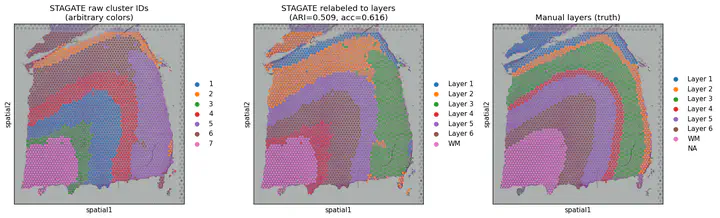 Spatial domains recovered on a DLPFC tissue section (slice 151676).
Hello, world 👋
I’m Jiawei Li, a current graduate student at the University of Southern California working at the intersection of machine learning and computational biology. I’m thrilled to be part of the Open Source Research Experience (OSRE'26) this year, contributing to UC Santa Cruz OSPO under the mentorship of Lijinghua Zhang. This post is a short introduction to me and to the project I’ll be building over the coming months.
The project: CauST
As part of OSRE'26, my proposal introduces CauST: Causal Gene Intervention for Robust Spatial Domain Identification.
Spatial transcriptomics lets us measure gene expression while preserving the physical location of each cell or spot within a tissue. A core task on this data is spatial domain identification — partitioning the tissue into coherent regions (for example, the cortical layers of the human brain) by combining what genes are expressed with where they are expressed.
State-of-the-art methods, such as graph attention autoencoders, do this well on clean data. But they remain vulnerable to technical confounders — batch effects, platform differences, and noise — that can be correlated with biology and quietly distort the domains a model recovers. When that happens, the “domains” reflect the experiment as much as the tissue.
CauST asks a causal question: which genes cause a spot to belong to a given spatial domain, as opposed to merely being associated with it through some confounder? By framing domain identification as a problem of causal gene intervention — intervening on gene expression and observing how domain assignments respond — CauST aims to learn representations that are robust to these confounders and that generalize across tissue sections, platforms, and batches.
Why it matters
Robust, reproducible spatial domains are the foundation for downstream biology: identifying disease-associated regions, mapping cell-type organization, and comparing tissue across patients. If the domains shift when you change the scanner or the batch, so does every conclusion built on top of them. Bringing causal reasoning into the pipeline is a step toward results we can trust across labs and datasets.
A first look
The figure below shows spatial domains recovered on a human dorsolateral prefrontal cortex (DLPFC) section — the kind of benchmark CauST is designed to handle. The left panel is the model’s raw clustering, the middle panel aligns those clusters to the annotated cortical layers, and the right panel is the expert “ground-truth” annotation. Getting that middle panel to match the right one robustly — across every section, not just the easy ones — is exactly the problem CauST sets out to solve.
What’s next
Over the OSRE'26 program I’ll be:
- formalizing the causal model behind spatial domain identification,
- implementing the gene-intervention mechanism on top of a graph-based spatial encoder,
- and benchmarking robustness against existing methods across multiple tissue sections and platforms.
I’ll be sharing progress, design decisions, and results here as the project develops. Thanks for reading — and feel free to follow along!